Data and AI are becoming increasingly important for the economy. Even though predictions about the size of future data and AI markets differ [1,2,3,4], they are meant to act as tailwinds to propel economic growth in the coming decades [5]. AI sits on top of the value of data, both personal and non-personal. However, due to its peculiar characteristics as an economic good, particularly to the risk of replicability, the lack of trust, and the huge amounts of data needed to make it truly valuable, companies are reluctant to share their data assets, most of which reside in corporate silos nowadays.
In this context, the European Data Strategy aims to create a single market for data that will allow it to flow freely within the EU and across sectors for the benefit of businesses, researchers, and public administrations. Central to this development is unlocking data assets and interoperability of data exchange services. In this blog entry, we summarise a couple of global initiatives originating in the EU aimed in that direction: the International Data Spaces (IDS) and the Gaia-X project.
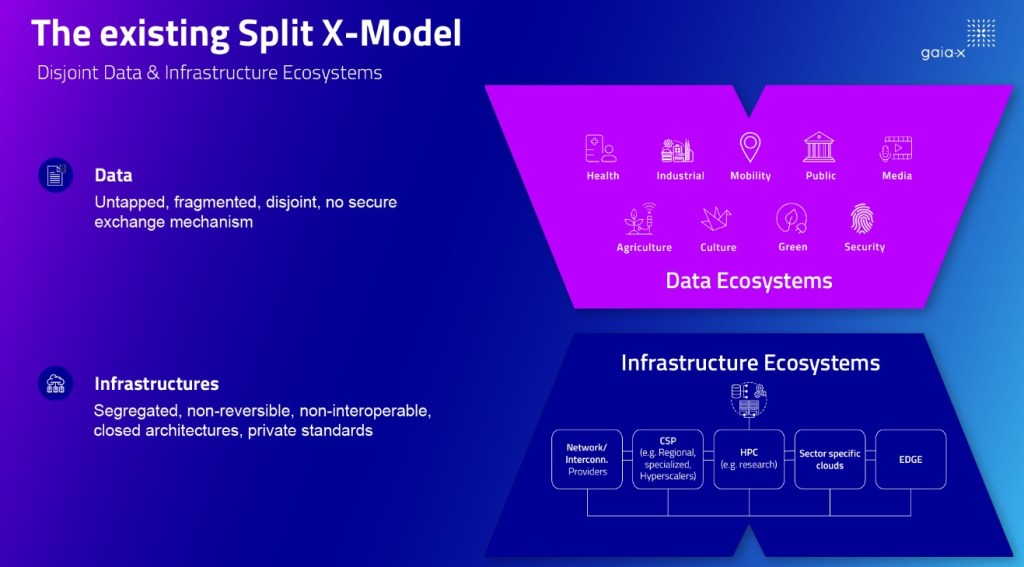
Image: Gaia-X framework. Split-X model.
International data spaces
IDS is a global framework defined by the International Data Spaces Association (IDSA), which groups more than 147 members from 28 countries that “share a vision of companies able to self-determine usage rules and realize the full value of their data in secure, trusted, equal partnerships” over a sovereign interoperable ecosystem. Companies include dozens of industry verticals, research institutions, solution developers, data and data service providers, and data consumers. The architecture specifies five different layers (business, functional, process, information, and system).
According to the IDS Reference Architecture Model (RAM), the design ambition is to integrate different platforms, stakeholders and businesses over the so-called IDS Data Connector. This is the central component that allows enterprise clouds, service providers, on-premise systems and connected devices to interact with any other party in the Data Space, and that provides for usage traceability, security, and trust. Connectors implement the DataSpace protocol, which defines schemas and web HTTPS calls for Participants to publish data, negotiate Agreements, and govern the transfer of data. In addition to IDS RAM, specifications for components are available in the IDS Global.
Remarkably, the architecture also defines the IDS Information Model, a domain-agnostic common language designed to facilitate interoperability in a Data Space. The Information Model, which is being consolidated with W3C’s Data Catalog (DCAT) v3.0, allows to describe, publish, provide, identify, and locate data products and reusable Data Apps, often referred to as “Digital Resources”. It goes beyond digital resources, and it also allows to describe Participants and Components in the ecosystem.
Gaia-X Project
The Gaia-X project was originally a German proposal launched at the Digital Summit in October 2019. The initiative intends to develop an open, transparent and secure digital ecosystem standard where data can be shared and services can be provided in an environment of trust. The high-level requirements for Gaia-X Architecture deal with interoperability and portability of data and services, sovereignty over data, security and trust. For that purpose, the architecture follows federation, decentralization, and openness design principles.
Gaia-X defines a Trust Framework (22.10 Release), a set of rules to become part of the ecosystem, and foresees verifiable credentials and linked data representations as a cornerstone of its future operations. It has already developed an identity component to verifiably identify the participants in the ecosystem. Participants and resources of the ecosystem are described by self-descriptions, machine-readable immutable cryptographically signed set of statements that are validated through a compliance process before being included in catalogs.
Interestingly, Gaia-X defines a data ecosystem and an infrastructure ecosystem. The former deals with data, data services, and data spaces, meaning secure and privacy-preserving infrastructure to pool, access, share, process and use data. The latter deals with storage and computing Nodes that execute Software Resources to process data, and Interconnection Services to ensure secure data exchange between Nodes. The project acknowledges the open Internet is not enough to fulfill the requirements of all services, hence it defines its own ecosystem of IT infrastructures to support the data ecosystem.
Gaia-X and IDS have some overlapping definitions and are closely related, they both try to build a community of trust around secure sovereign data sharing among organizations in a data space, although they are complementary in a way. IDSA has been an active member of Gaia-X from the beginning of this initiative, and IDS is, according to IDSA, a central element of the Gaia-X data ecosystem (see Gaia-X and IDS. Position paper).
References
[1] N. Henke, J. Bughin, M. Chui, J. Manyika, T. Saleh, B. Wiseman, and G. Sethupathy. The age of analytics: Competing in a data-driven world. McKinsey Global Institute. Dec. 2016
[2] G. Micheletti; N, Raczko, C. Moise; D. Osimo, and G. Cattaneo. European DATA Market Study 2021–2023. IDC & The Lisbon Council. May 2023
[3] PWC Consulting. Sizing the prize What’s the real value of AI for your business and how can you capitalise? 2017
[4] J. Bughin, J. Seong, J. Manyika, M. Chui, and R. Joshi. Notes from the AI frontier: Modeling the impact of AI on the world economy. McKinsey Global Institute. 2018
[5] G. Brown, M. El-Erian, M. Spence, with R. Lidow. Permacrisis: A Plan to Fix a Fractured World. Simon and Schuster, Sept. 2023.
 Santiago Andrés Azcoitia
Deja un comentario