
The transition to greener energy sources and the reduction of greenhouse gas (GHG) emissions are essential to mitigating climate change and ensuring a sustainable future. Although the ICT sector currently accounts for a modest share of global emissions, its contribution is expected to rise significantly due to the rapid growth in data and computing demand across all industry verticals. This surge is driven by the deployment of 6G, which will enable AI-driven services by providing ultra-reliable, low-latency, and high-capacity connectivity across the cloud–edge continuum.
Next week, I’ll be presenting our working paper, “A Framework to Incentivise Green Networks and Infrastructure in the 6G Mobile Ecosystem,” which I co-authored with Sergio Illescas Cabiró and Zoraida Frías, at the 33rd ITS European Conference. I’m excited about traveling to Edinburgh, spending a few days with a multidisciplinary community of researchers, and attending insightful sessions on NTN communications and their impact on the industry, AI, platform economics, content, and regulation, among other topics.

Our working paper (already available in Econstore) introduces a techno-economic framework to evaluate policy mechanisms for promoting greener networks and infrastructure in the 6G ecosystem. This framework builds on 5G slicing and the technical capabilities under development within the 6GREEN project, which aims to measure, monitor and expose information on carbon emissions associated with 6G networks and services throughout the value chain.
However, we identified that such technical enablers and awareness alone are not sufficient to incentivise investment in sustainable infrastructure and the adoption of green services. Despite these technological capabilities, market dynamics often hinder investment in greener infrastructure—particularly when returns on investment are unclear or when green energy solutions are more expensive than conventional ones. In such cases, policy interventions become essential to realign incentives throughout the value chain.

The model captures interactions between stakeholders under varying market conditions, integrates sustainability key performance indicators (KPIs) such as carbon emissions, and operationalises the concept of Decarbonisation Level Agreements (DLAs) as an extension of traditional Service Level Agreements (SLAs). Four policy options are compared: laissez-faire, infrastructure subsidisation, uniform DLA enforcement, and tiered DLAs allowing for green premium services. Results show that while strict DLAs and subsidies can reduce emissions, they may also introduce cost and capacity constraints unless carefully designed. Tiered approaches, which combine regulation with market-driven incentives and user awareness to distinguish conventional and green premium services, offer a more balanced and scalable path toward sustainability.
Our research has been funded by the European Union’s HORIZON Europe project 6GREEN (Grant agreement ID: 101096925).
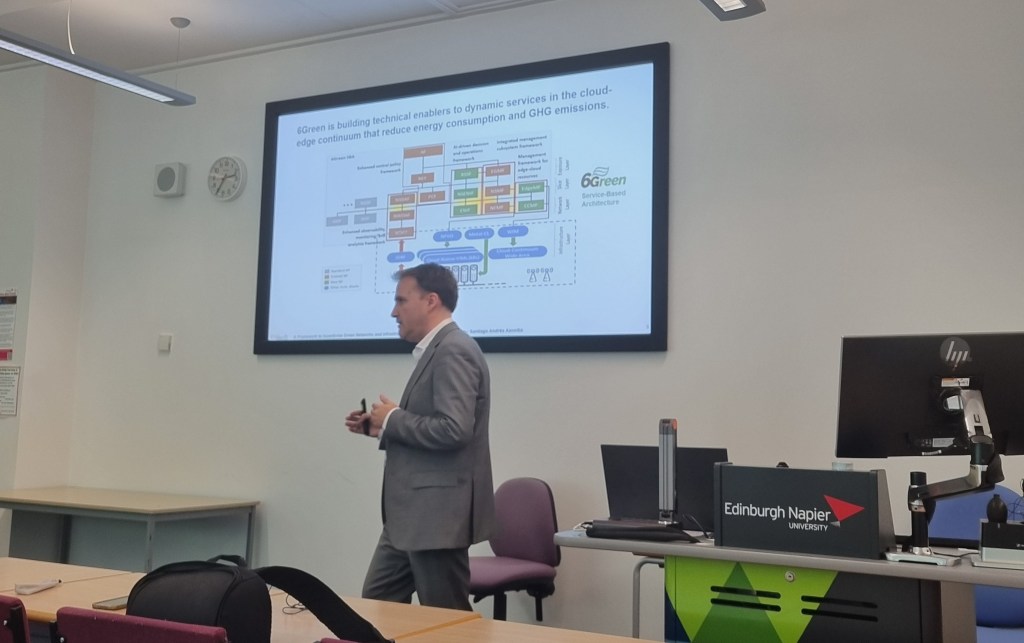
Presenting the paper at ITS Europe
 Santiago Andrés Azcoitia
Deja un comentario