Our paper, «Neutrality and Competitiveness of Data Intermediaries under the DGA: Reality Strikes Back» has been accepted for publication in the prestigious journal Computer Law and Security Review (SJR Q1).
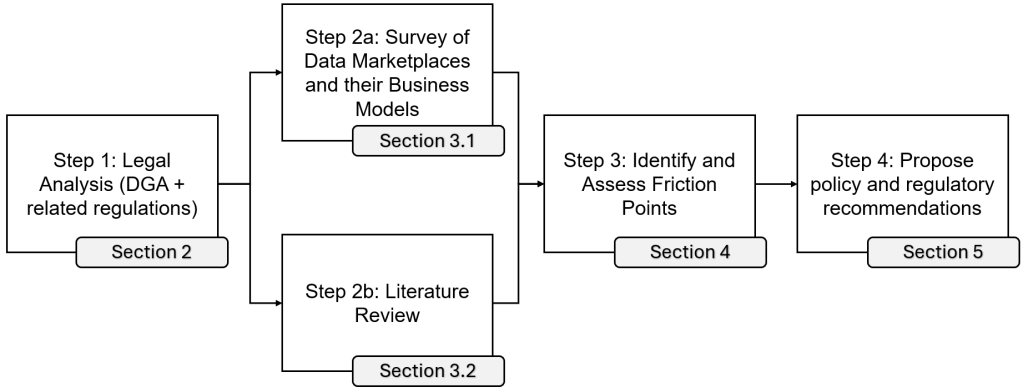
In the paper, we analyse the interplay between recent European regulations (particularly the DGA) and commercial data marketplaces. We identify friction points, illustrate them with evidences obtained by revisiting and updating information of entities included in my former survey of this market, and derive policy and regulatory recommendations. The paper substantially expands and formalises earlier work of mine on the topic. Our methodology can be applied to new regulations affecting nascent markets still in a strongly innovative stage, and the conclusions align with proposals put forward in the Digital Omnibus.
Huge thanks to the team that took on the challenge of writing this paper: my colleagues Andrea Palumbo, Alexandra Papageorgiou and Tervel Bobev from CiTip@KU Leuven, and George Konstantinidis from the University of Southampton. Multidisciplinarity in action! This work stems from the tasks we undertook in the European project UPCAST, which has recently been finalised, and the Consortium meeting we held in Southampton almost one year and a half ago. Thanks to ETS Ingenieros de Telecomunicación and Universidad Politécnica de Madrid for supporting this research line. I also thanks the reviewers that took their time to help us improve the manuscript with their valuable comments.
I hope the paper contributes to the ongoing discussion on the recent Digital Omnibus, and sheds light on the effects of the existing regulation on European data intermediation service providers (DISPs).
Abstract:
In this paper, we examine whether the Data Governance Act (DGA) regime on data intermediation services is adequate to achieve its intended purpose of fostering trust, neutrality, and sustainability in data sharing. We review the state of the art in data intermediation technologies in both industry and academia and discuss its interplay with the regulation. We identify friction points with existing data markets and anticipate challenges in emerging contexts, such as intermediaries delivering machine learning models or using confidential computing techniques. Finally, we explore potential amendments to, or interpretations of, the DGA required to promote a data intermediation model that is both economically viable and neutral.
 Santiago Andrés Azcoitia
Deja un comentario