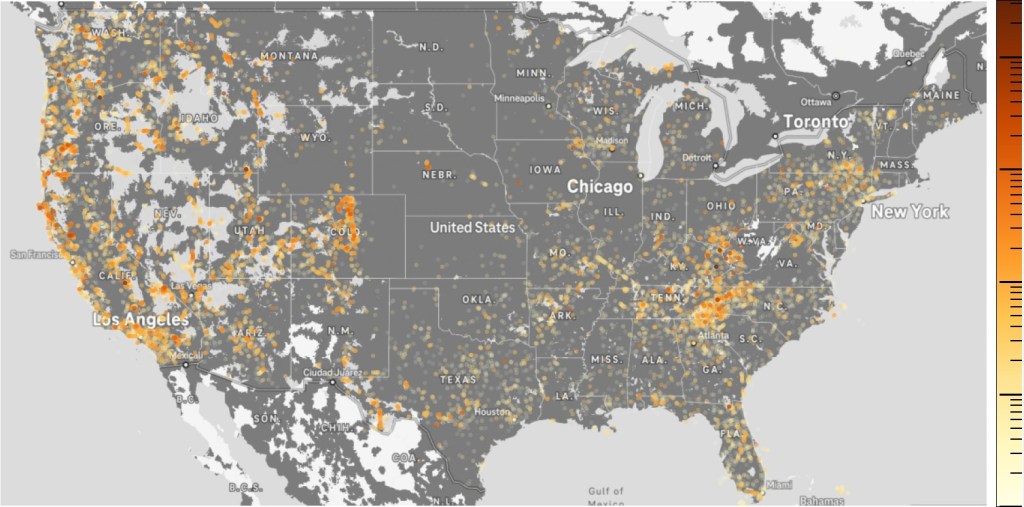
NEW PAPER!! We are excited to present the first measurement study of Starlink’s Direct-to-Cell service, a joint effort by UPM’s ICT Group and WePlan Analytics. The study offers an initial look at Starlink’s 4G RAN connecting directly to everyday smartphones. The service was recently launched by Starlink in the U.S. in partnership with T-Mobile and using its spectrum in a beta phase for SMS services only, with voice and broadband upgrades coming later this year.
Despite its short lifespan, the crowdsourced measurements collected by WePlan already provide valuable insights into how the service operates and how it was deployed. Moreover, the rich information they provide about Starlink’s 4G RAN has enabled us to make evidence-based estimations about the QoS users can expect from future broadband services and to anticipate ways Starlink could improve that QoS in the future.
Our paper «Direct-to-Cell: A First Look into Starlink’s Direct Satellite-to-Device Radio Access Network through Crowdsourced Measurements» was published in the prestigious IEEE Communications Magazine. Since its publication as a preprint on May 2025, it is having significant impact on media, and has been reposted by industry analysts. Big special thanks to the team that made this possible: Jorge García Cabeza, Javier Albert-Smet, Zoraida Frías, Luis Mendo, and Eduardo Yraola.
Post updated on December 2025
Abstract: Low Earth Orbit (LEO) satellite mega-constellations have emerged as a viable access solution for broadband connectivity in underserved areas. In 2024, Starlink, in partnership with T-Mobile, began beta testing an SMS-only Supplemental Coverage from Space (SCS) service. This marks the first large-scale deployment of Direct Satellite-to-Device (DS2D) communications, allowing unmodified smartphones to connect directly to spaceborne base stations. This paper presents the first measurement study of deployed DS2D technologies. Using crowdsourced mobile network data from the U.S. between October 2024 and July 2025, we provide evidence-based insights into the capabilities, limitations, and future evolution of DS2D technologies for extending mobile connectivity. We find a strong correlation between the number of satellites deployed, the number of unique cell identifiers measured, and the volume of measurements, concentrated in accessible areas with poor terrestrial network coverage, such as national parks and sparsely populated counties. Stable physical-layer measurements were observed throughout the period, with a 24-dB lower median RSRP and a 3-dB higher RSRQ compared to terrestrial networks, reflecting the SMS-only usage of the DS2D network during this period. Based on the SINR measurements collected, we estimate the expected performance of the announced DS2D mobile data service to be around 3 Mbps per beam in outdoor conditions. We also discuss strategies to expand this capacity up to 18 Mbps in the future, depending on key regulatory and business decisions, including allowable out-of-band emissions, permitted number of satellites, and availability of spectrum and orbital resources.


Deja una respuesta