
With the transition toward machine-centric communications, latency has become a key performance indicator (KPI) in assessing the quality of service (QoS) of modern communication networks. Deterministic ultra-low latency is now a strict requirement to increase the productivity of Cyber-Physical Production Systems, the Internet of Robots and intelligent systems in general. Since many machine-to-machine communications flow through wireless networks, the characterization, prediction, and interpretation of end-to-end latency in such complex environment has become a highly relevant problem to address.
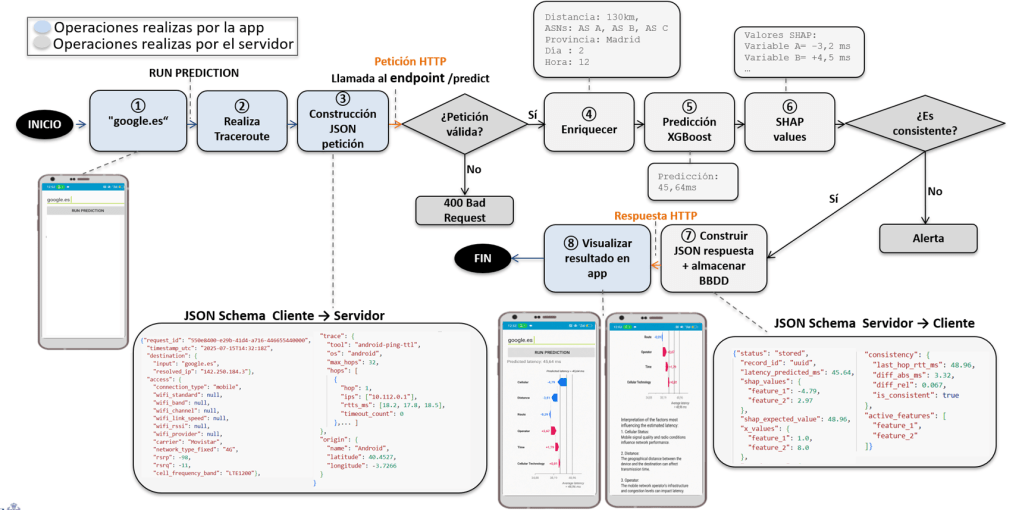
Our student, Mónica Salmador has just defended her ME Thesis aimed at designing and implementing an ML-based system for the characterization, prediction, and interpretation of end-to-end latency in wireless networks, including both mobile and fixed access networks. The system combines (i) continuous retraining of models using real traceroute measurements collected through crowdsourcing techniques by WePlan Analytics, a partner of the GTIC research group, (ii) a cloud-deployable service, and (iii) an Android application that enables end users to easily perform and submit their own measurements to the server in exchange for receiving comparisons with latency measurements collected from other users, while also obtaining an interpretation of the causes behind the identified differences.
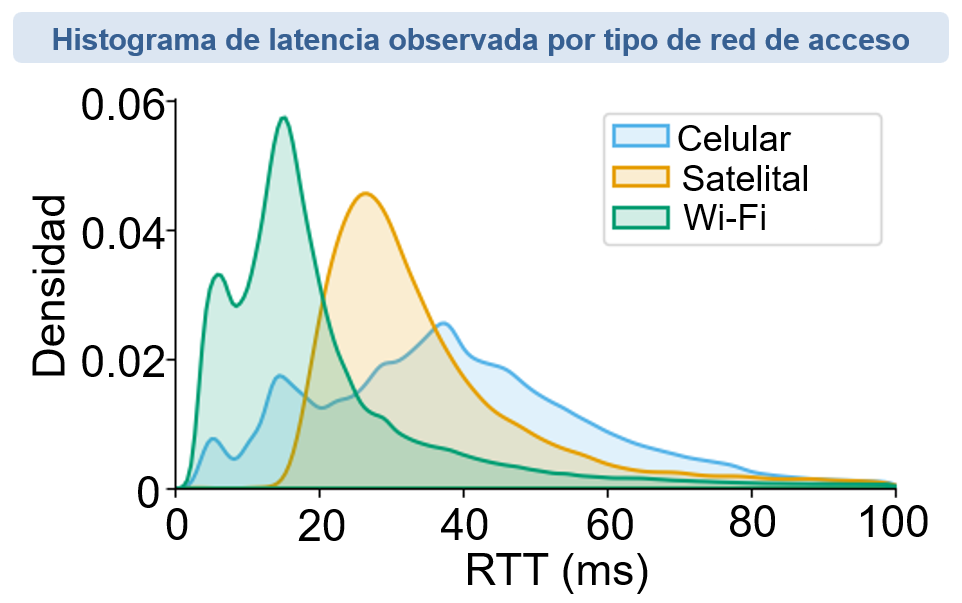
Using a massive dataset of more than 12 million measurements of fixed, mobile, and satellite networks in Spain, Mónica engineered features spanning radio access network performance, IP-route topology, device status, and geographic context, and train an XGBoost regression model that outperformed state-of-the-art models. By combining four explainability techniques, she showed that features related to the end-users’ devices contribute a non-negligible independent effect due to their heterogeneity, This adds to the classical dominant factors related to geographic distance, IP routing, wireless access network technology and status. Moreover, she demonstrated the adaptability of the model to emerging technologies like LEO Starlink, and showcased the value of this model for anomaly detection and network benchmarking.
It was truly a pleasure guiding and supervising Mónica throughout the last course alongside Jorge García-Cabeza, who co-tutored the Thesis. After a fantastic presentation, she obtained a 9.5/10 —a grade that, in my opinion, still underestimates her amazing and complete work. Not only did she produce a full system that will go to market soon, but also co-authored a top scientific paper and prepared a fantastic demo that will help us attract students in the years to come.
Thank you both for the amazing teamwork and best of luck for Mónica in her future career!
Finally, a big thank you to WePlan Analytics for continuous support of our research. They collect incredible, comprehensive crowdsourcing data that supports many different applications and helps operators, towercos, and regulators all over the world.


Deja una respuesta